


Standard or Custom Bulk material
What is better for your project?
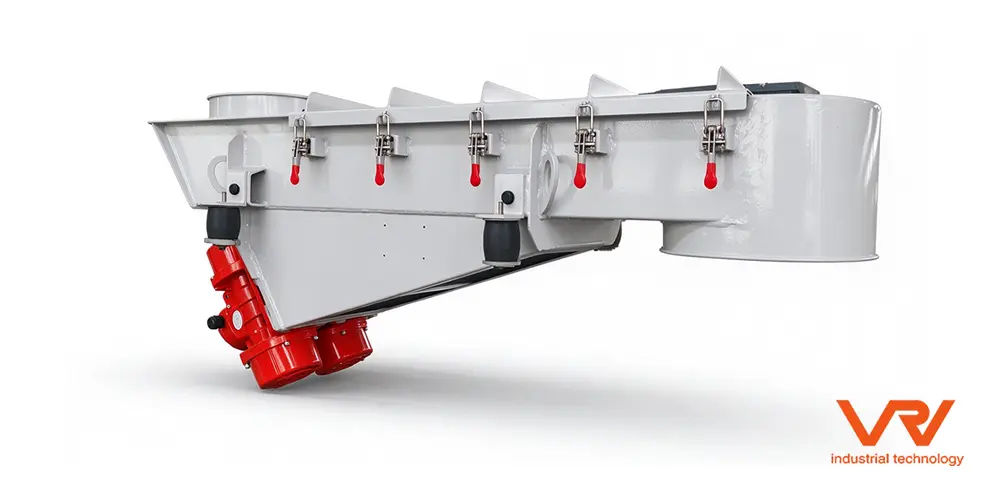
At the feeding stage of a bulk material line, problems are easy to misread. A dusty workstation, a hopper that keeps forming arches over its outlet, or a crusher that trips under an uneven load are often blamed on downstream equipment, when the real cause sits at the feeder. An enclosed motor vibrating feeder solves these issues at their source. It combines a sealed, dust-tight trough with twin vibratory motors that keep material moving forward in a controlled, steady stream. Overfeeding, material bridging, and uneven flow are three problems that derail bulk-handling lines. Here is how a motor-driven vibrating feeder solves each one — and what to check before you specify one.
Open trough feeders, uncovered transfer
points and loosely connected inlet or outlet flanges let fine material escape
into the plant. The consequences go beyond a dusty floor:
Dust usually appears at the interface
between the hopper, the feeder and the next piece of equipment, because
vibration and material flow force fine particles out through any gap.
Fine, damp, sticky or fibrous material
tends to cling together in the hopper and trough. Material forms an arch or
bridge above the outlet, the flow pulses instead of running steadily, and at
times the channel blocks completely. Operators then spend production time
raking, poking or clearing the trough manually.
Common causes include:
When the feeder delivers material in
surges, every machine downstream absorbs that uneven load: crushers take
intermittent overloads, screens process uneven layer depths, and belts and
mixers see repeated peaks and dips. This raises power draw, accelerates wear,
and shortens the life of downstream equipment. The line then runs below its
stable capacity even though the upstream supply hopper appears full.
A motor vibrating feeder uses two or
more vibratory motors mounted under the trough as its excitation source. In a
twin-motor design, the two motors rotate in opposite directions. Their
horizontal centrifugal forces cancel each other out, while the vertical
components add together and combine into a straight-line (linear) vibrating
motion along the trough angle.
Material in the trough is repeatedly lifted
and slid forward by this vibration, discharging through the outlet in a
continuous, even flow. An enclosed vibrating feeder places this trough
inside a sealed body with a removable cover, so the material stream is
contained from the inlet flange to the discharge outlet.
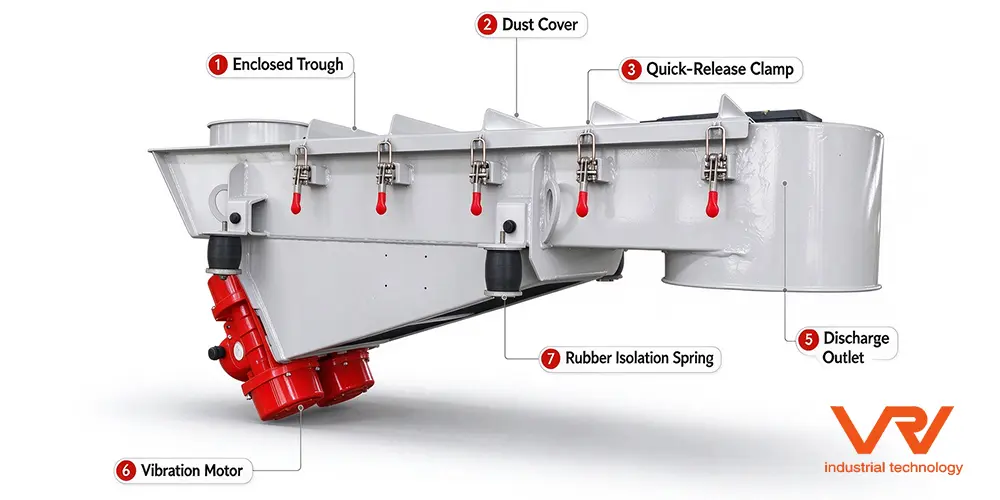
Typical components include:
Compared with an electromagnetic feeder, a
motor-driven unit delivers larger amplitude and is better suited to heavy-duty
bulk flow, large troughs and abrasive material, while still allowing adjustable
output through speed control.
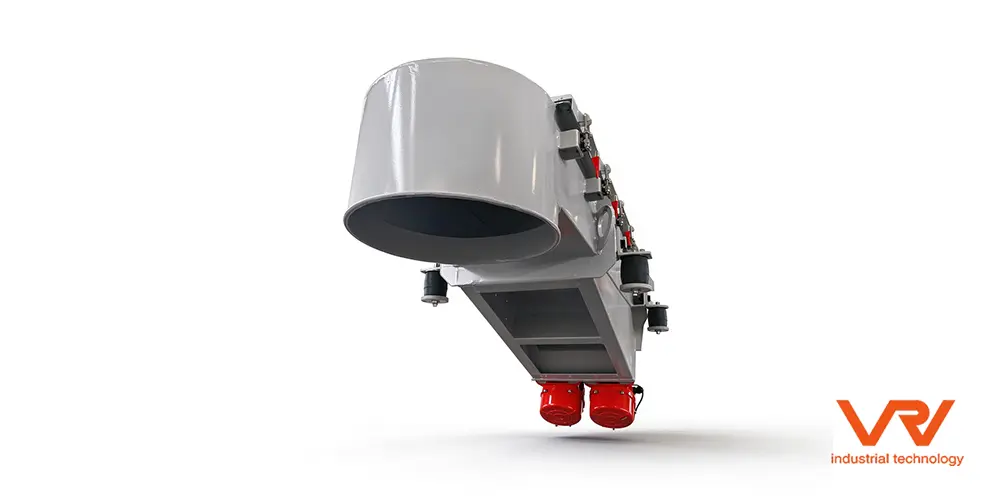
The enclosed trough and covered top contain
material throughout the feeding path. Flanged connections at the inlet and
outlet are designed for flexible, dust-tight couplings to the hopper above and
the conveyor, crusher or mixer below. The result is a cleaner transfer point:
less airborne dust, less spilled material around the machine, and a lower risk
of contamination from outside the process.
This sealed layout is especially relevant
for powders, chemical granules, minerals, recycled material and other bulk
products where dust control or material purity matters.
The linear vibration keeps material active
inside the trough and breaks the settled arches that form in hoppers and
channels. Because a vibrating feeder has no internal screw blade, paddle or
rotary pocket, there is no mechanism that can seize on a lump, tramp piece or
fibrous tangle. Material advances by vibration rather than being pushed by a
rotating part, which reduces the chance of mechanical blockage.
Where material is damp or sticky, trough
geometry, liner selection and vibration parameters can be matched to the actual
bulk material during engineering, so the flow channel stays open instead of
building up residue.
Instead of surging, the feeder discharges
material at a steady rate that the crusher, screen, belt conveyor or mixer can
absorb continuously. A consistent feed depth keeps downstream equipment working
near its designed load, smooths power peaks, and reduces the wear caused by
repeated overload cycles. This is how a well-matched feeder protects the
investment made in the rest of the production line.
The feed rate can be adjusted to suit the
process: changing vibration frequency through an optional VFD, or adjusting
eccentric block settings on the vibratory motors, allows output to be matched
to crusher capacity, batching requirements or downstream speed.
The trough rests on rubber isolation
springs rather than a rigid frame mount. These springs support the vibrating
body while isolating most vibration from the supporting structure, which limits
vibration transmitted to the plant frame, adjacent machines and building floor,
and helps lower operating noise compared with an un-isolated arrangement. The
springs also simplify both seated and suspended installation, depending on the
layout above and below the feeder.
The top cover is fastened by a row of
quick-release toggle clamps that open without tools. Operators can lift the
cover to inspect material flow, clean residue, replace wear liners or check the
trough interior, then close and seal it again quickly. A vibrating feeder has
few wearing parts compared with screw or rotary feeders: there are no screw
flights, chain pockets or rotary valves to maintain, which keeps routine
service short and predictable.
To match different materials and line layouts, an enclosed motor vibrating feeder can be configured around the following points:
Area
Standard arrangement
Configurable options
Trough material
Mild steel plate with wear-resistant
lining
High-wear abrasion-resistant steel,
stainless steel 304 / 316L for chemical or hygienic requirements
Wear protection
Replaceable liner plates in high-wear
zones
Thicker liners, ceramic or special liners
for highly abrasive ores
Drive
Twin vibratory motors under the trough
Motor size and pole count matched to
capacity, angle and bulk density
Feed-rate control
Fixed operation or simple regulation
VFD speed control, remote or automated
line integration
Installation
Floor-supported on spring mounts
Suspended hangers, framed supports, side
or rear mounting
Connections
Flanged inlet and discharge
Square or round outlets, flexible rubber
/ canvas connectors, observation windows
Inspection
Removable covered top
Access doors, observation ports,
wear-level inspection points
Enclosed motor vibrating feeders are used wherever lumps, granules or powders must be transferred from a hopper, silo or bin into the next process step in a controlled way:
VRV is a China-based manufacturer of vibrating feeders, screens and conveying equipment for bulk material handling lines, supplied to customers across mining, quarrying, cement, chemical, recycling and other industries. Rather than selling a fixed standard unit, each feeder is engineered around the material properties, required throughput, installation space and connection dimensions of the customer's line.
Our enclosed motor vibrating feeders are built around a welded trough, twin vibratory motors and isolation springs, with covered inspection access for cleaning and liner replacement. Material grade, liner thickness, drive size and control configuration are selected for the actual application, and the machine can be integrated with hoppers, crushers, vibrating screens, belt conveyors and batching systems.
If you are comparing a motor vibrating feeder with an electromagnetic unit, the general rule is straightforward: choose a motor-driven vibrating feeder for heavy bulk flow, larger amplitude and abrasive or high-capacity duty; choose an electromagnetic feeder for fine, gentle, precision feeding where small-amplitude, high-frequency control is preferred.
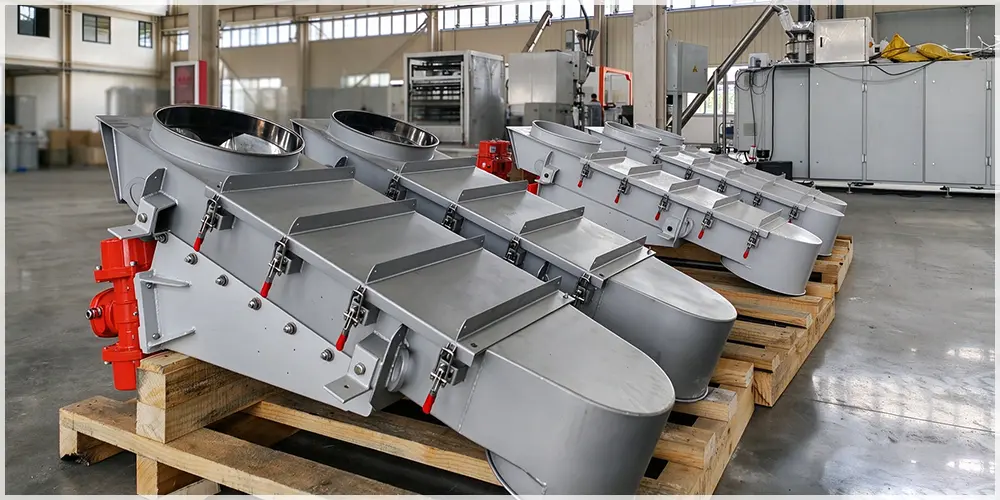
Dust leakage, choke-ups and unstable downstream loads usually trace back to the feeding stage. An enclosed motor vibrating feeder addresses all three at once: a sealed trough contains the dust, continuous twin-motor vibration keeps material flowing and prevents bridging, and a uniform discharge rate protects the crushers, screens and conveyors downstream. Combined with isolation springs for vibration control and a quick-release cover for maintenance, it is a reliable, low-maintenance link between the storage hopper and the rest of the process line.
Discuss your application with VRV. Send us your material type, particle size, capacity requirement and connection dimensions, and we will recommend a suitable enclosed motor vibrating feeder arrangement.
call us :
008617855911791 e-mail : sales@vrvibratory.com


 ipv6 network supported