


Standard or Custom Bulk material
What is better for your project?

Vibratory feeders form the backbone of controlled material handling across powder, chemical, lithium, mining and plastic processing lines. Two mainstream designs dominate site specification: electromagnetic vibrating feeders and motor vibrating feeders. Many process engineers and procurement teams struggle to match the right unit to their feed targets, especially when fine powder dosing, continuous bulk feeding or rapid flow adjustment sits at the core of the process. This guide lays out practical, site-tested distinctions to narrow down your selection.
An electromagnetic vibrating feeder relies on an electromagnetic vibrator and leaf spring resonant assembly. Pulsed magnetic pull releases the trough in fast, small cycles, creating low-amplitude, high-frequency micro-jumps for material movement. Feed rate changes happen instantly once the controller signal shifts.
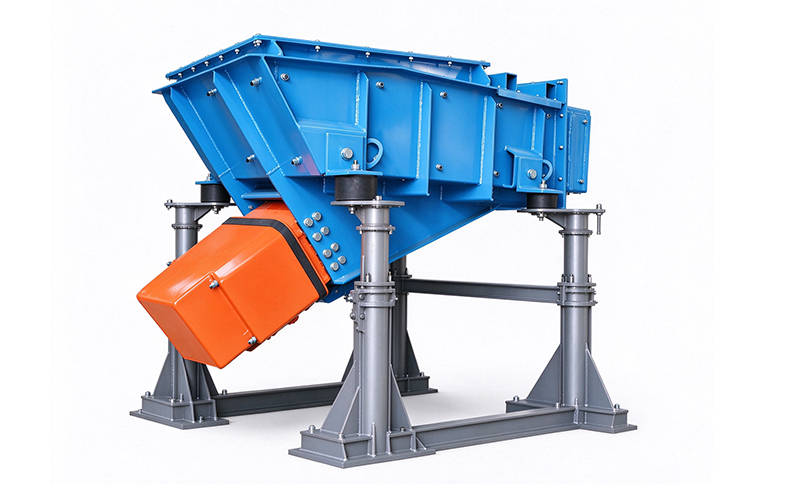
A motor vibrating feeder uses one or two eccentric vibratory motors bolted directly to the trough body. Rotating eccentric weights generate centrifugal force to drive vibration. Amplitude stays relatively stable unless you manually re-adjust the eccentric blocks on the motor ends.
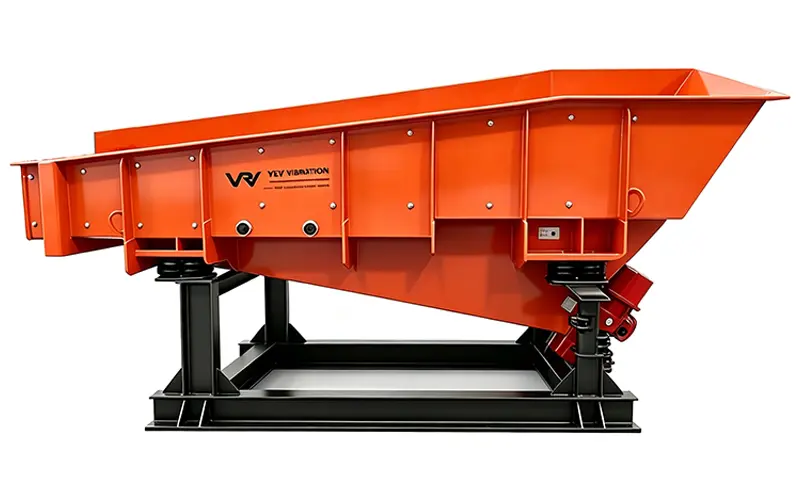
| Item | Electromagnetic vibrating feeder | Motor vibrating feeder |
|---|---|---|
| Adjustment response | Near-instant, stepless flow tuning via controller. Suitable for closed-loop dosing systems. | Slow adjustment. Tuning requires shutdown and physical repositioning of eccentric blocks. Not fit for real-time feedback loops. |
| Amplitude & frequency | Small amplitude, high frequency. Gentle material movement, reduces particle breakage and powder segregation. | Larger amplitude, lower frequency. Strong throwing force to move heavy, coarse or sticky bulk material. |
| Power consumption | Low continuous power draw. Energy efficient under stable fine-feed conditions. | Higher power input, especially for high throughput models. |
| Maintenance focus | Leaf springs and exciter coil inspection. No rotating bearings inside the excitation unit. | Vibratory motor bearing lubrication, seal check and eccentric block fastening. Bearings are the primary wear point. |
| Suitable material | Fine powder, ultra-fine filler, light granular material. Works well for lithium cathode/anode powder, carbon black, pigment and fine quartz powder. | Coarse ore, crushed stone, large plastic regrind, heavy aggregate, high-density bulk material. |
| Typical throughput ceiling | Low to medium capacity. Most standard models serve dosing ranges below 20 t/h. | Wide high-capacity range. Heavy-duty versions can handle hundreds of tonnes per hour. |
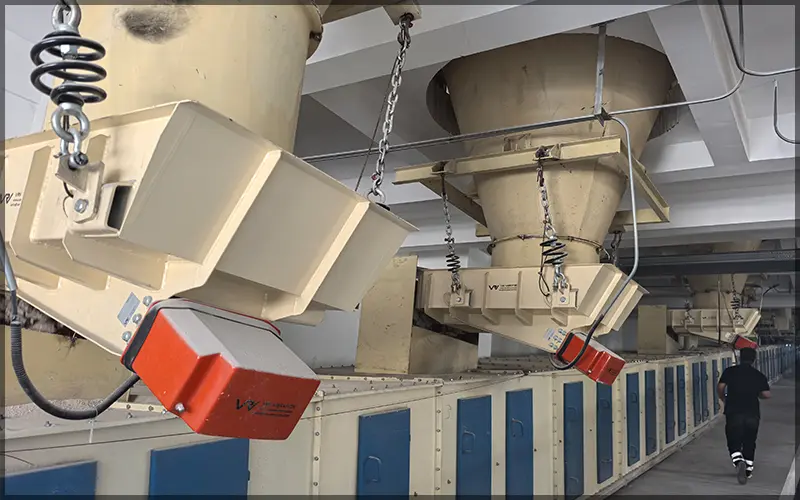
Choose the electromagnetic type when your process needs precise, repeatable dosing. It fits silo outlet feeding ahead of sieve screening, continuous powder weighing, and automated batching lines where the control system needs to ramp feed up or down without stopping the feeder.
This unit also performs well with fragile materials. The mild vibration profile keeps intact particle shape and avoids excessive dust generation when the trough is fitted with sealed side plates and wear-resistant lining.
It has clear limits. Electromagnetic feeders struggle with wet, sticky material that clings to the trough surface. Heavy lump material will overload the resonant system and shorten service life. It is not the pick for primary feeding on large mining crushing circuits.
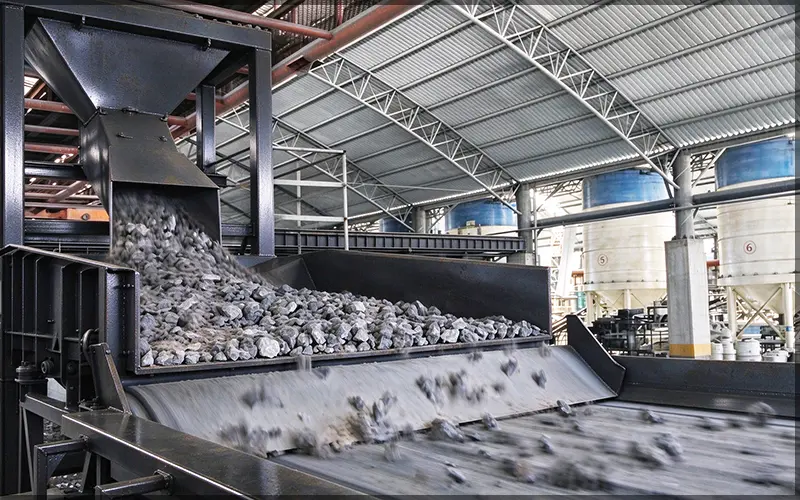
Go with a motor vibrating feeder for heavy, unrefined feed. Mines, quarries and recycling plants commonly install these under large hoppers to feed primary crushers and coarse screening decks.
The robust excitation structure tolerates uneven material loading and occasional oversized chunks. Operators value its simple mechanical layout: spare vibratory motors are widely available, and field technicians can complete repairs without specialised control calibration tools.
Its main drawback is poor flexibility for precision dosing. Once set, the feed rate cannot be modified remotely or on the fly. Frequent recipe changes in a batching plant will create operational headaches.
The core difference comes from excitation source and vibration behaviour. Electromagnetic models use magnetic resonance for fast, fine flow control. Motor-driven units use rotating eccentric weights for powerful, fixed-amplitude bulk conveying.
Electromagnetic vibrating feeders are preferred for fine powder dosing. High-frequency micro-vibration maintains consistent powder flow and minimises segregation, matching the requirements of lithium material and chemical additive production.
Select a motor vibrating feeder for high-capacity bulk feeding, coarse rock, heavy aggregate or heavily contaminated material where precise flow trimming is not required.
Standard electromagnetic designs are not built for high tonnage. For bulk rates above 20 t/h, motor vibrating feeders are the more practical option.
Electromagnetic vibrating feeders require a matching control unit to regulate excitation current and feed output. Basic motor vibrating feeders run directly from mains power; a controller is optional and only used for simple on/off or soft start functions.
Start your evaluation from process priority, not equipment price. If consistency of dosing and responsiveness to control signals top your checklist, the electromagnetic vibrating feeder delivers the required performance. If raw feed volume, lump tolerance and straightforward field maintenance are the deciding factors, the motor vibrating feeder will be the reliable solution.
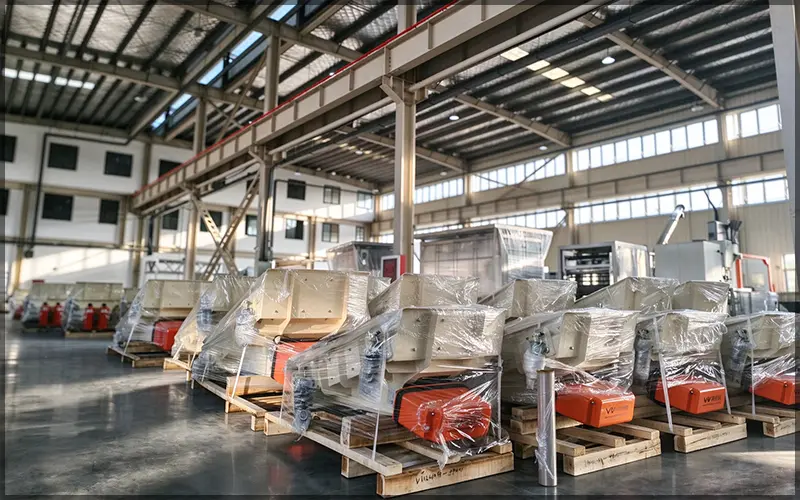
For custom trough dimensions, IP ratings or lining upgrades to match your material properties, share your feed rate, bulk density and operating environment details for a tailored layout proposal.
call us :
008617855911791 e-mail : sales@vrvibratory.com


 ipv6 network supported